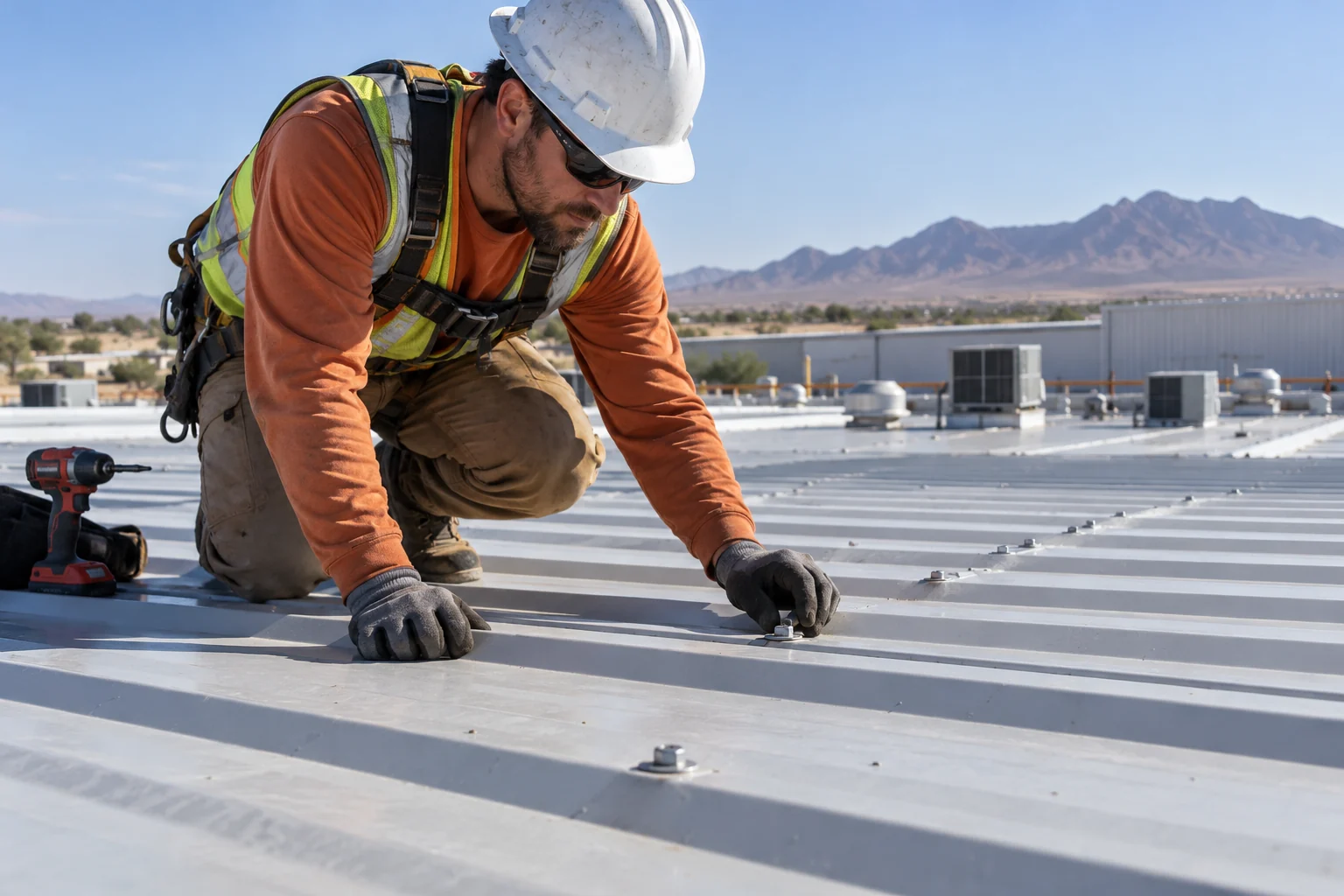
Look At Flashing Connections
Flashing links roofing to a wall, curb, pipe or edge. A sound repair must account for both the roof surface and the adjoining component. Treating only the most visible crack may leave another entry route.
Old patching material can hide the original condition. Preparation may be needed before the appropriate correction becomes clear.
Consider The Retained Roof
The roof around a defect must be capable of supporting the repair. Localized deterioration may need removal, while sound areas can potentially remain. An assessment distinguishes those conditions before materials are selected.
Repair Services For Commercial Roof Defects
We offer leak investigation, flashing repair, metal roof repair and storm-damage assessment. The work addresses the actual defect and the condition that surrounds it. You can request service with a description of the symptom even if the roof material is unknown.
A repair request may begin with water indoors or with visible roof damage reported during other work. In either case, the inspection needs to identify what failed. The most obvious mark is not always the complete repair area, and the nearest roof detail is not automatically the water-entry point.
Why A Transition May Need Reconstruction
A flashing detail carries roofing protection through a change in shape or material. If it is loose, deteriorated or poorly connected, simply covering a visible opening may not restore the full detail. Removal and reconstruction with compatible materials can be necessary.
The condition of the adjoining wall, curb or pipe also matters. A sound connection requires suitable surfaces on both sides. The assessment should consider the complete interface rather than treating the roof membrane as the only component involved in every leak.
Evaluate Previous Sealant And Patches
Older repairs may obscure the original detail. Some can remain when their condition and compatibility are suitable; others may need removal before the defect can be understood and corrected. A thicker collection of patches is not automatically a stronger repair.
The materials selected for new work should match the roof system and retained surfaces. If several products have been used, preparation can be more involved. Identifying that requirement is part of the repair assessment rather than an optional cosmetic cleanup.
Check For Affected Material Below
Water entering at a flashing can reach insulation or other parts of the assembly. The extent of affected material may differ from the size of the visible opening. The scope needs to address that condition before the surface is closed.
Localized damage does not automatically require replacing the entire roof. It does require a suitable boundary between repaired and retained materials. The inspection establishes where a reliable connection can be made and whether further investigation is needed.
Coordinate With Roof Equipment Work
Recent equipment changes can alter curbs, penetrations and nearby traffic. Include that history when requesting repair. The information can help focus the assessment without presuming the equipment work caused the problem.
Future changes also need appropriate roofing details. A repaired roof remains a system with specific materials and connections. New penetrations or unrelated patching should not be assumed compatible simply because they appear to cover an opening.
Use A Clear Repair Request
Identify the property and affected area, then describe when the symptom appears. If water is present inside, note the location and pattern from a safe area. You do not need to inspect the roof edge or disturb old flashing yourself.
The estimate depends on the actual detail, preparation and affected materials. A general roof-area calculation cannot establish those requirements. Inspection provides the basis for an appropriate scope and price.
Does More Sealant Make A Flashing More Reliable?
Additional material cannot compensate for every deficient connection. If the base is loose, deteriorated or incompatible, another layer may simply cover the same weakness. A detail may need preparation or reconstruction to connect properly to the roof and adjoining component.
The suitable correction is specific to the system and condition. A membrane flashing, metal transition and previously coated curb can require different approaches. Describe what is known about earlier repairs, including whether they changed the symptom. The inspection should evaluate the whole transition and any affected surrounding material before the new work is selected. A neat surface appearance is not the same as a sound completed roofing detail, and the estimate should reflect the work necessary to establish that connection.
Get A Free Estimate
For a Litchfield Park flashing or leak concern, identify the building and report what can be observed safely. Include timing, prior repairs and access restrictions. Do not disturb the detail to collect more information. Inspection determines whether a local correction or reconstructed connection is appropriate, together with any surrounding material needed for a dependable repair.