Commercial Roof Leak Repair
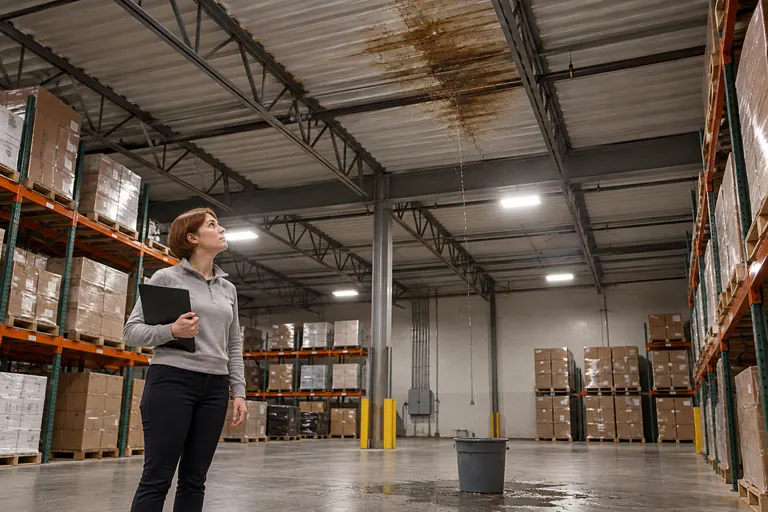
Newer roofs still leak at details, and a trace finds whether the source is a scupper, a curb, or a wall joint. The trace starts inside under the stain.
Leak tracing and repair
Commercial roof repair in Laveen for newer retail centers along the South Mountain Freeway, where parapet scuppers carry most of the monsoon runoff off each roof.
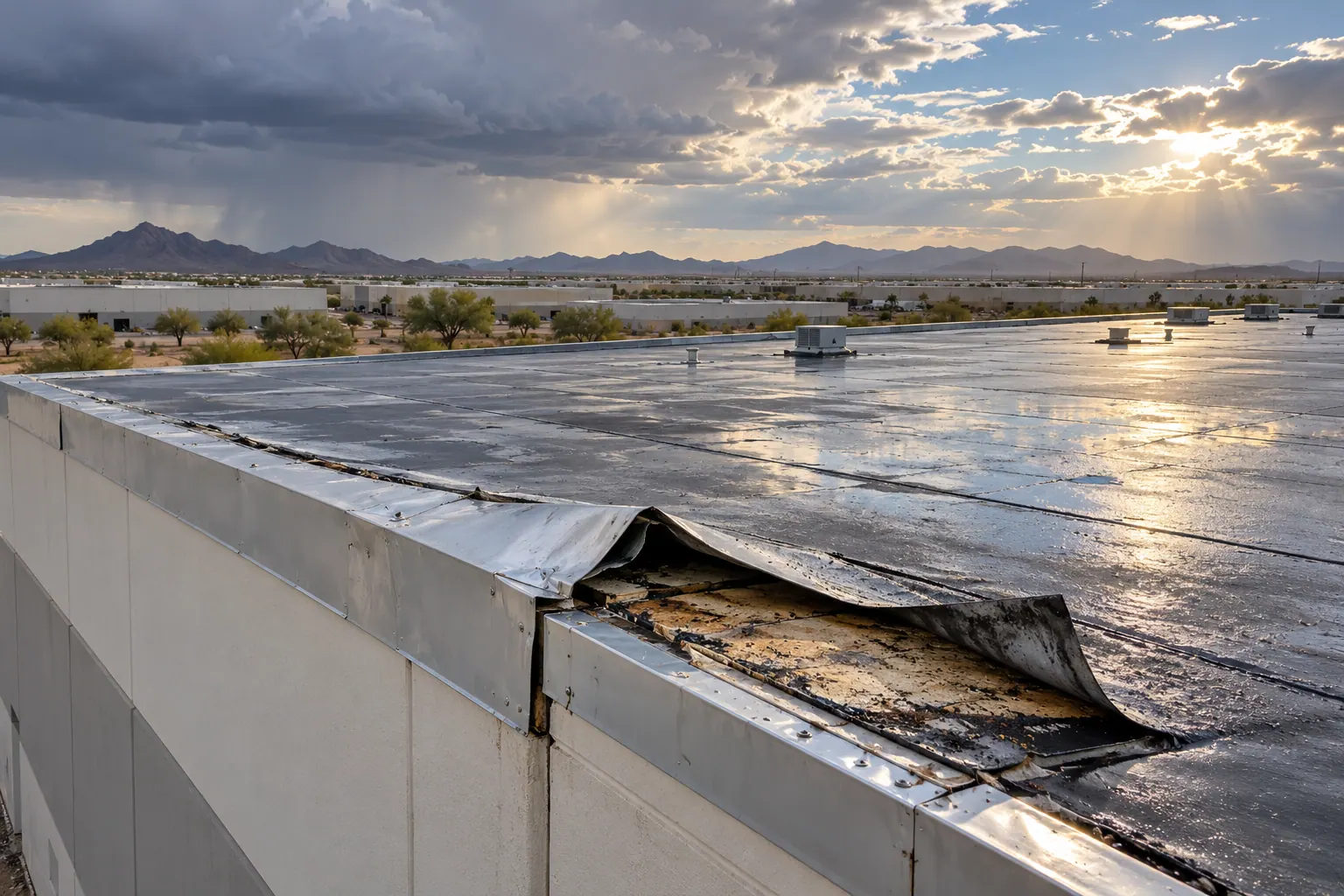
Laveen sits between South Mountain and the Salt River, and its newer retail centers drain flat roofs through scuppers in the parapet walls.
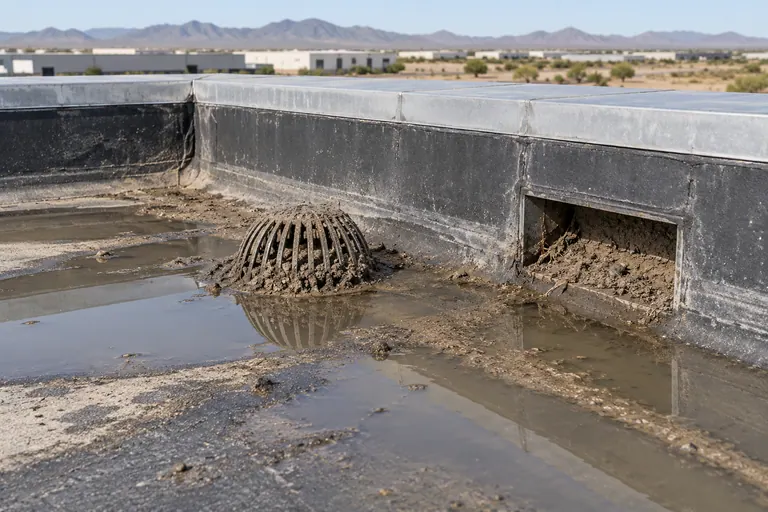
A scupper handles steady rain well. A monsoon burst can bring more water than the opening passes, and debris in it makes that worse. Water then rises against the parapet and finds the joints in the wall flashing and the scupper liner. Newer buildings are no exception.
Repairs here reseal scupper liners and their corners, renew wall flashing around the openings, and clear conductor heads and downspouts. Where water backs up again and again, an overflow scupper set higher in the wall gives it a second way out. Each opening gets checked during the same visit.
Five details along the parapets carry most of the storm risk.
Plan view, not to scale
Sealant at the liner corners pulls loose and lets water into the wall. New sealant and corner patches close them.
Flashing around each opening takes the full force of backed-up water. New flashing laps into the liner.
Debris fills the head on the outside wall, and water spills down the stucco. Clearing the head restores the flow.
Outflow wind lifts membrane edges and coping on the windward side. Refastened edge metal holds the membrane down.
Wind-driven rain gets under loose curb flashing on newer units too. Resealed counterflashing stops the leak.
Boots on newer roofs still dry out in the sun and open at the collar. New boots go on at the collar.
When a scupper keeps up with a storm, water leaves the roof before it reaches the wall joints.
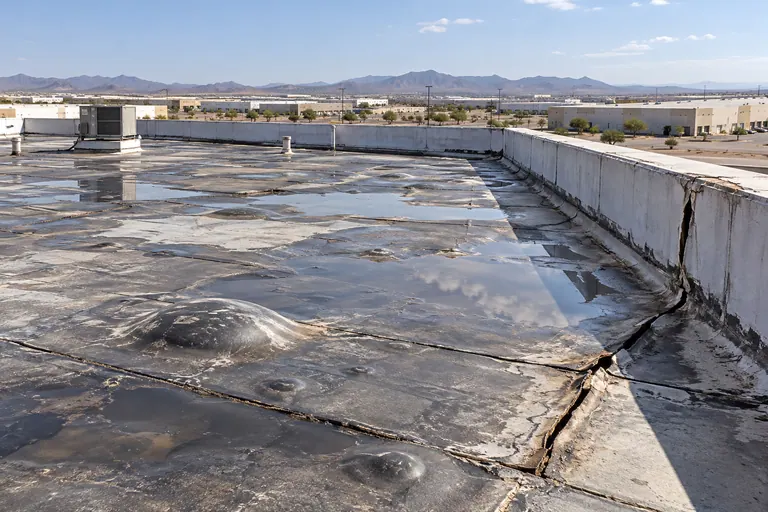
Two services fit most Laveen retail roofs.
Newer roofs still leak at details, and a trace finds whether the source is a scupper, a curb, or a wall joint. The trace starts inside under the stain.
Leak tracing and repair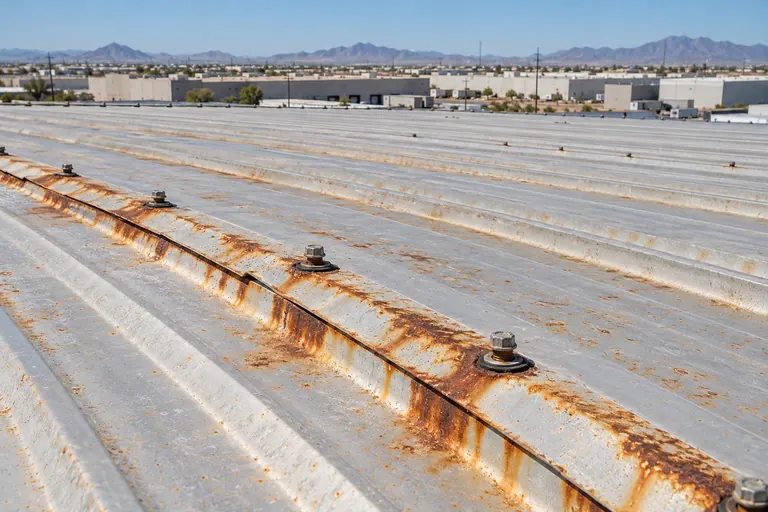
Metal canopies, trim, and coping on retail buildings loosen in monsoon wind, and their fasteners and laps get refastened and resealed. Trim gets new screws and sealant.
Metal roof repair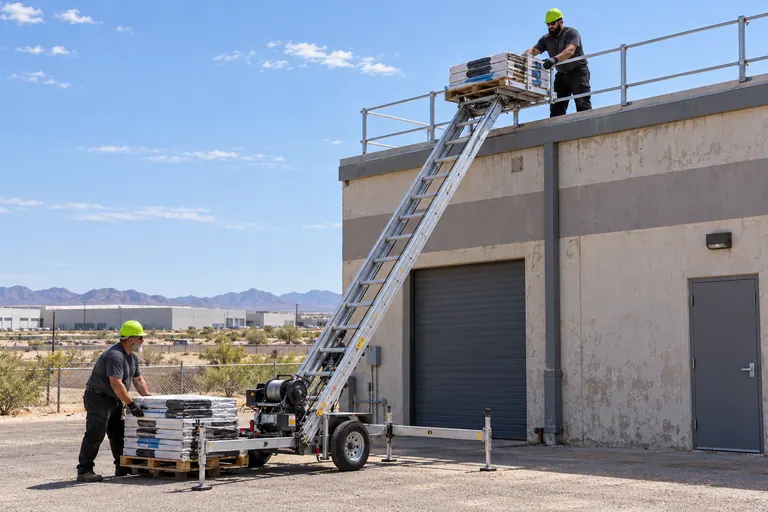
Call during or after the storm with the building and the wall where water collects. We check the scuppers and flashing at that wall.
Storm repairs follow four steps.
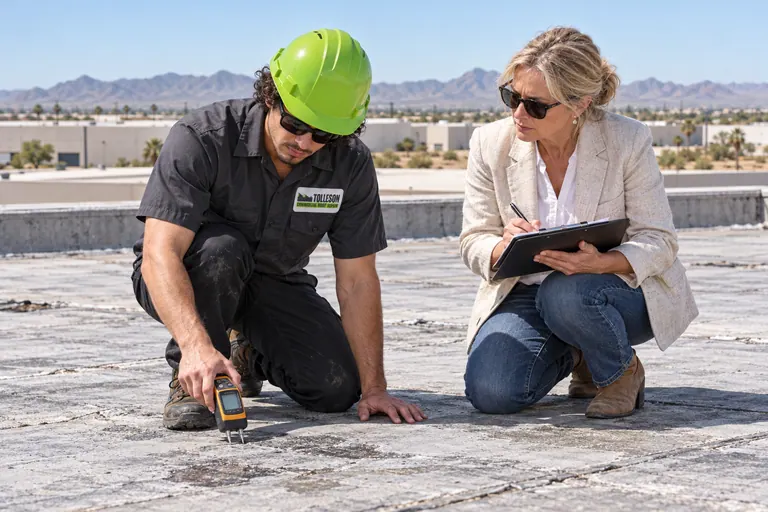
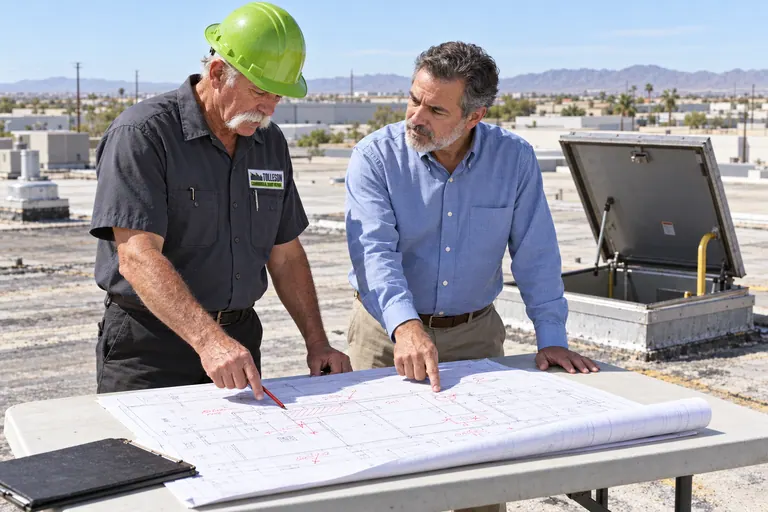
We walk each parapet wall, look into every scupper and conductor head, check edges and curbs, and photograph storm damage before cleanup. Photos come before any cleanup.
Photos, measurements, and notes on the storm date go into a report you can share with your insurer. The storm date goes on every page.
Scupper liners get resealed, wall flashing renewed, and overflow scuppers added where water keeps rising. Debris comes off the roof first.
Conductor heads and downspouts are cleared and checked so water leaves the wall freely. You get the photos with the report.
Laveen sits south of the Salt River, southeast of Tolleson.
Drain cleanout on dusty industrial-park roofs.
Walk pads and curb repairs on retail roofs.
In-place repairs for older built-up roofs.
What Laveen retail owners ask about storms and scuppers.
Start the day you find it, before cleanup. Photograph torn membrane, bent edge metal, displaced panels, and dented units, then each ceiling stain and any wet stock, with dates.
Note the storm date and when the leaking started, and keep receipts for temporary leak control. Call your insurer or agent early; our inspection photos and notes can go into that file.
Newer membranes resist heat and UV better, but details still fail. Scupper liners, wall flashing, and curb seals carry most of the stress on a new roof, and those get checked first.
Torn membrane at the edges, bent coping and edge metal, scuppers packed with debris, and loose curb flashing on rooftop units. Each gets photographed before cleanup.
The photos and storm notes go into one report, which the property manager can pass to the insurer or keep with the building file.
A second scupper set higher in the parapet than the main one. If the primary scupper or drain clogs, water leaves through the overflow before it rises far enough to find the wall joints.
Laveen is a village inside Phoenix, so the City of Phoenix Planning and Development Department handles commercial permits. The inspection notes whether a repair needs one.
Sometimes. Widening a scupper means cutting the parapet and fitting a larger liner, and the wall construction decides whether that works. Adding an overflow scupper is often the simpler fix.
The photos and storm notes go into one report, which the property manager can pass to the insurer or keep with the building file.
Before monsoon season begins on June 15 and again after it ends on September 30, plus after any dust storm that leaves debris on the roof.
Move stock away from the drip, catch the water, photograph the ceiling and the floor, and let the property manager know. The manager can call us with the suite and the time it started.
The photos and storm notes go into one report, which the property manager can pass to the insurer or keep with the building file.
Tell us which wall takes on water in a storm. We inspect, repair, and photograph it.
Want A Call Back About Your Roof?
Leave a name and number, or call (623) 310-0161 now.