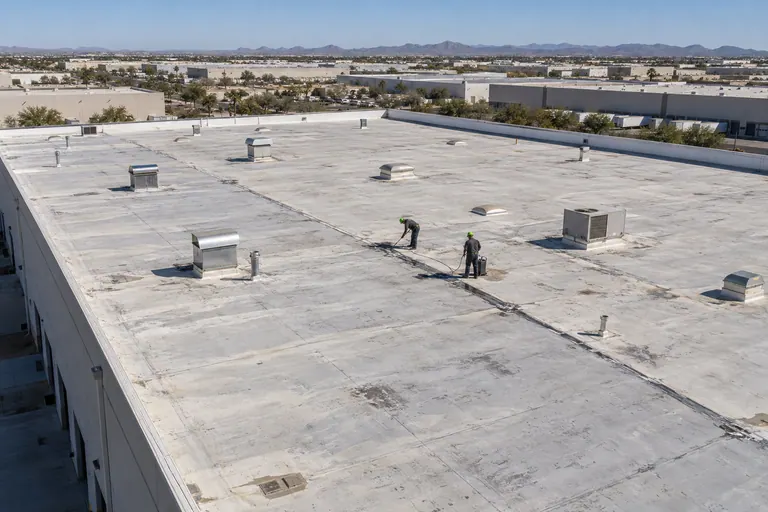
Flat Roof Repair
Most Litchfield Park office and retail roofs are low-slope membrane, and their repairs center on wall flashing and scuppers. Wall flashing gets renewed up to the coping.
Flat roof repair
Commercial roof repair in Litchfield Park for smaller office and retail buildings, where parapet walls, coping, and through-wall scuppers decide whether the roof stays dry.
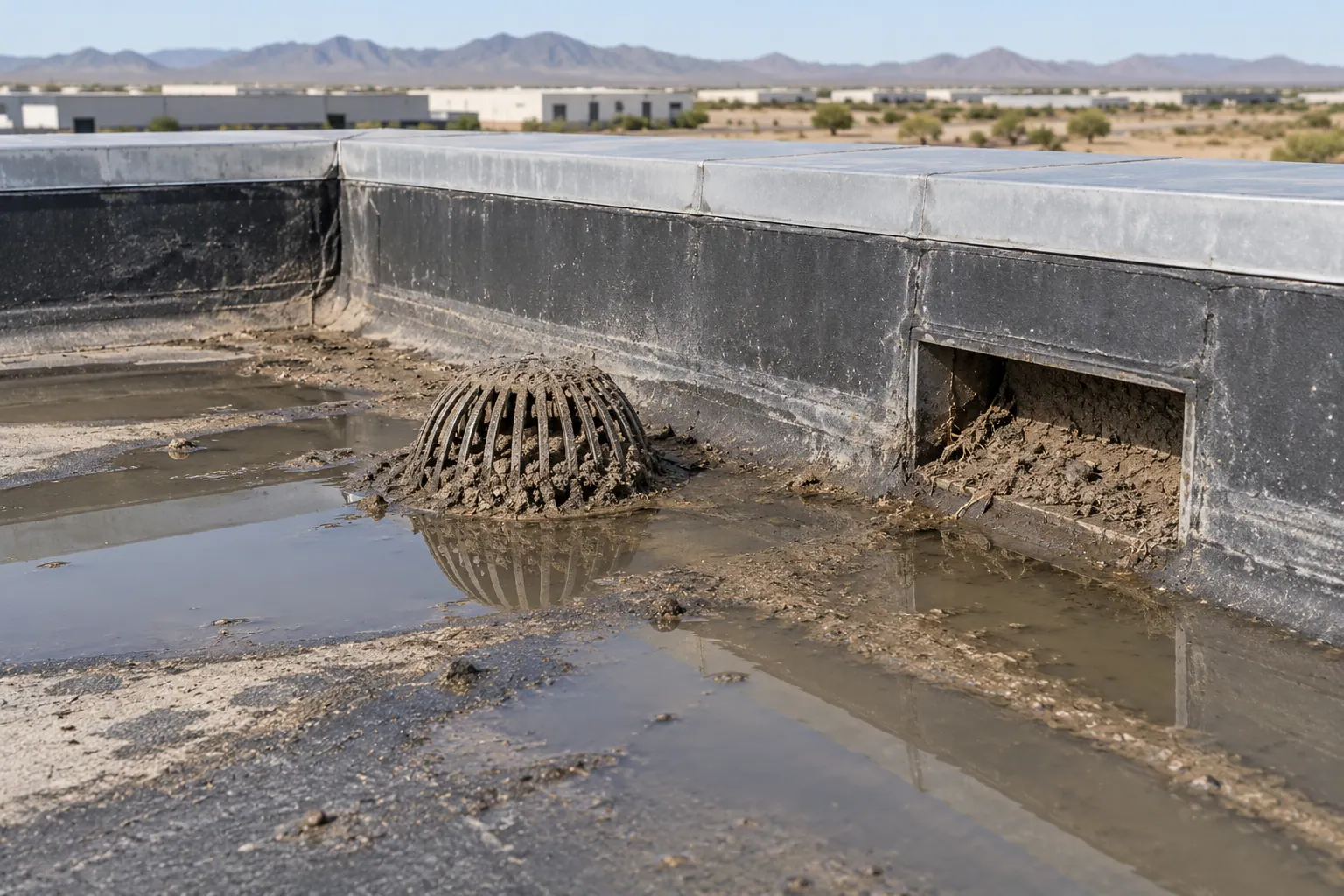
Low office and retail buildings here hide their roofs behind parapet walls, and the water leaves through scuppers cut into those walls.
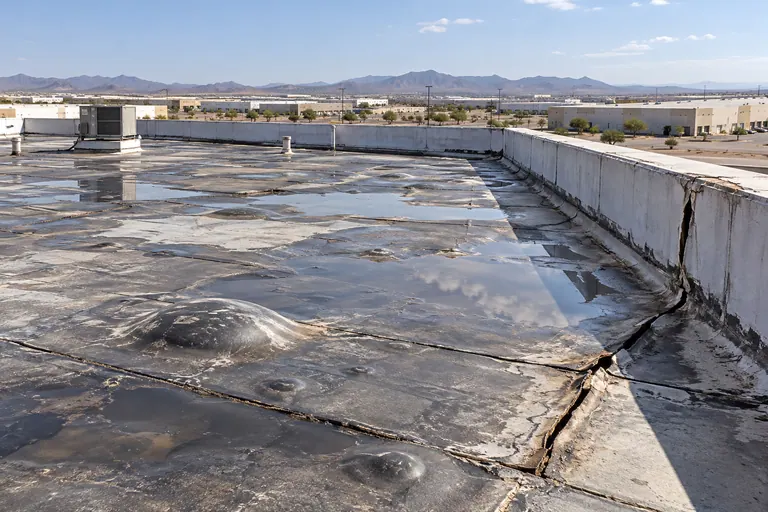
A parapet gives water three ways in: through cracked coping on top, behind loose wall flashing on the roof side, and around the scupper box where the wall opens. Each one can stain the inside of an exterior wall. Smaller buildings show these stains fast.
We repair the coping joints, refasten or replace the wall flashing, and reflash scupper boxes so the membrane laps cleanly into the liner. Clogged conductor heads and downspouts get cleared on the same visit. The wall stays dry from the coping down.
Five details along the walls cause most leaks on these smaller roofs.
Plan view, not to scale
Sealant at the joints between coping sections dries out and lets water into the wall. Fresh sealant and new fasteners close them.
Liner corners crack, and water runs into the wall below the opening. A new liner corner and flashing fix it.
Flashing pulls away where the membrane turns up the parapet. New flashing runs up and under the coping.
Smaller roofs carry a single drain, so one clog sends the water straight to the scuppers. Clearing it takes pressure off the walls.
One rooftop unit near a wall shares its runoff with the closest scupper. Its curb flashing gets checked with the wall.
Laps near the walls stay wet longer after rain because the parapet shades them. Probing them is part of the wall check.
Water that gets into a parapet runs down inside the wall, so stopping it at the top saves the wall below.
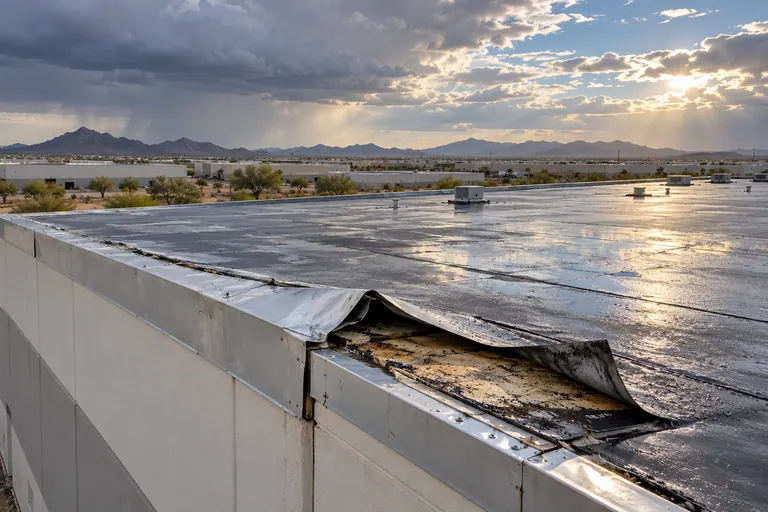
Two services fit most Litchfield Park office and retail roofs.
Most Litchfield Park office and retail roofs are low-slope membrane, and their repairs center on wall flashing and scuppers. Wall flashing gets renewed up to the coping.
Flat roof repair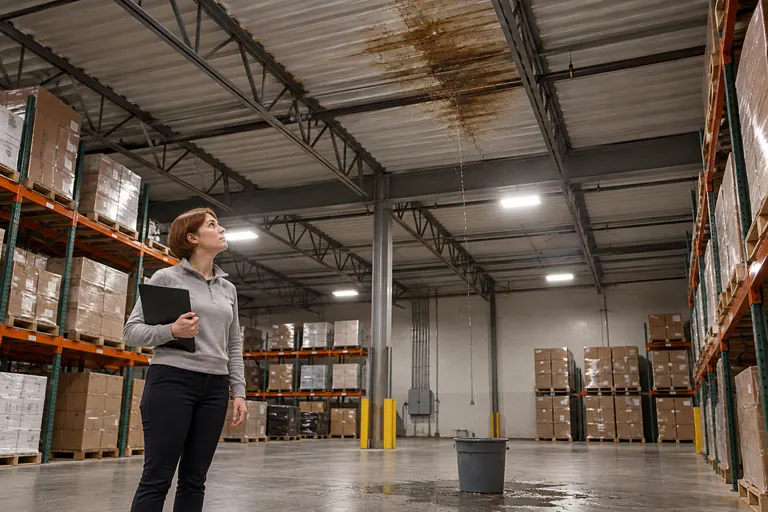
Stains on an exterior wall can start at the coping, the scupper, or a window, and tracing tells which one it is. The trace starts at the inside wall.
Leak tracing and repair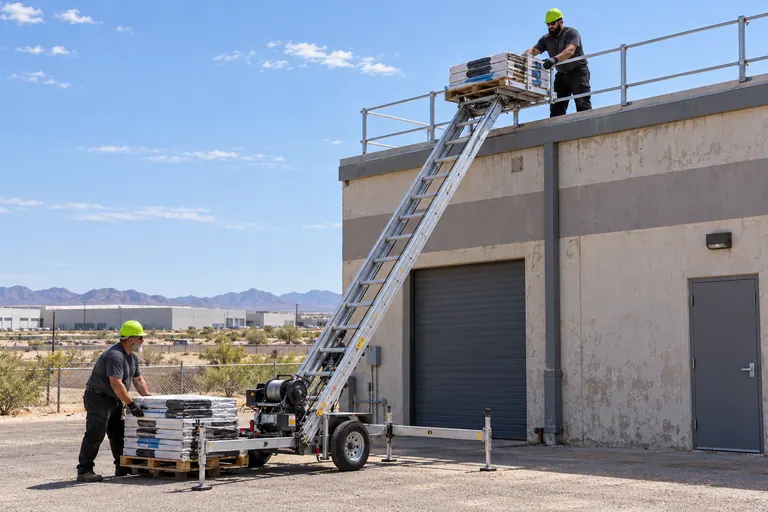
That pattern often starts at the parapet. Call and tell us which wall, and we will check the coping, flashing, and scupper above it.
Wall-side repairs follow four steps.

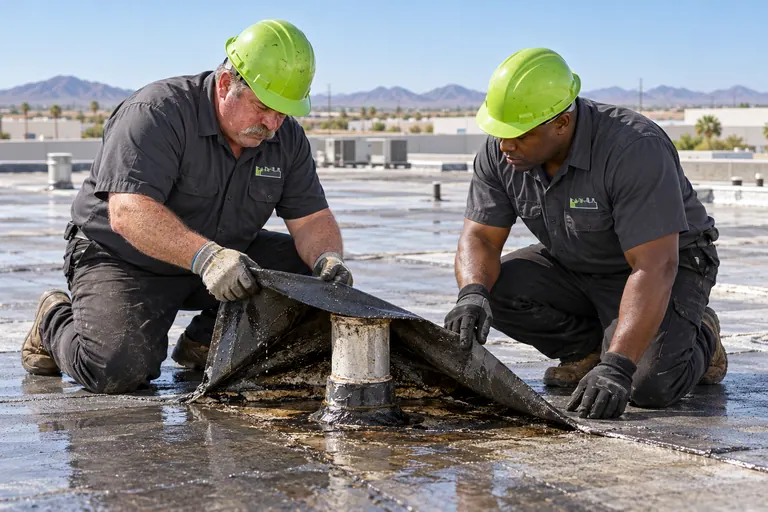
We walk the parapet line, check coping joints and wall flashing, look into each scupper, and match inside stains to the wall above. Each wall gets its own notes.
Where the source is unclear, one section of coping or one scupper gets tested at a time. A helper inside watches for the drip.
Coping gets resealed first, then wall flashing, then the scupper, so each fix sheds water onto the next. Fasteners on the coping are replaced as needed.
You get photos of each wall section repaired, labeled by side of the building. The photos match the wall names in your notes.
What owners of smaller Litchfield Park buildings ask.
A good repair holds about as long as the roof around it, as long as that membrane or metal is still in decent shape.
Wet insulation under a patch, brittle membrane at a sealed seam, or a clogged drain left in place shortens that life, and so do foot traffic and skipped upkeep. On an older roof, repairs buy time to plan.
Most coping only needs its joints resealed and loose fasteners replaced. Caps bent by wind or rusted through get replaced section by section with matching profiles.
A single wall with resealed coping and new flashing at a scupper takes a day or less on most small buildings. Several walls, or a replaced scupper box, add time.
On small buildings the walls are often the whole repair, and the open field needs little work.
Yes. Water that gets behind wall flashing or into a scupper box runs down inside the parapet and shows up as a stain on the wall or around a window, far from any roof opening you can see from inside.
The City of Litchfield Park Building Department. Its building permit application covers commercial work, and the inspection notes whether your repair scope needs one.
Wind direction and sun both play a part. The wall that takes the most wind-driven rain, or the one whose sealant faces the afternoon sun, wears out first, so its coping and flashing open before the others.
On small buildings the walls are often the whole repair, and the open field needs little work.
A scupper sized for steady rain can fall behind in a heavy monsoon burst, and debris in the opening makes it worse. Clearing the scupper and conductor head before June helps, and an overflow scupper can go in where one is missing.
Most scupper boxes repair well. Cracked liner corners get resealed and the membrane is flashed back into the box. A box that has rusted through or pulled away from the wall gets replaced with a new liner.
On small buildings the walls are often the whole repair, and the open field needs little work.
Tell us which wall shows the stain. We check the parapet, repair it, and send photos.
Want A Call Back About Your Roof?
Leave a name and number, or call (623) 310-0161 now.