Commercial Roof Leak Repair
If a stain keeps returning after a flat roof patch, the water is entering somewhere else, and a full leak trace finds it.
Commercial roof leak repair
Flat roof repair for Tolleson warehouses, cold-storage buildings, and retail centers, from split TPO seams to drains and parapet flashing, matched to the membrane on your roof.
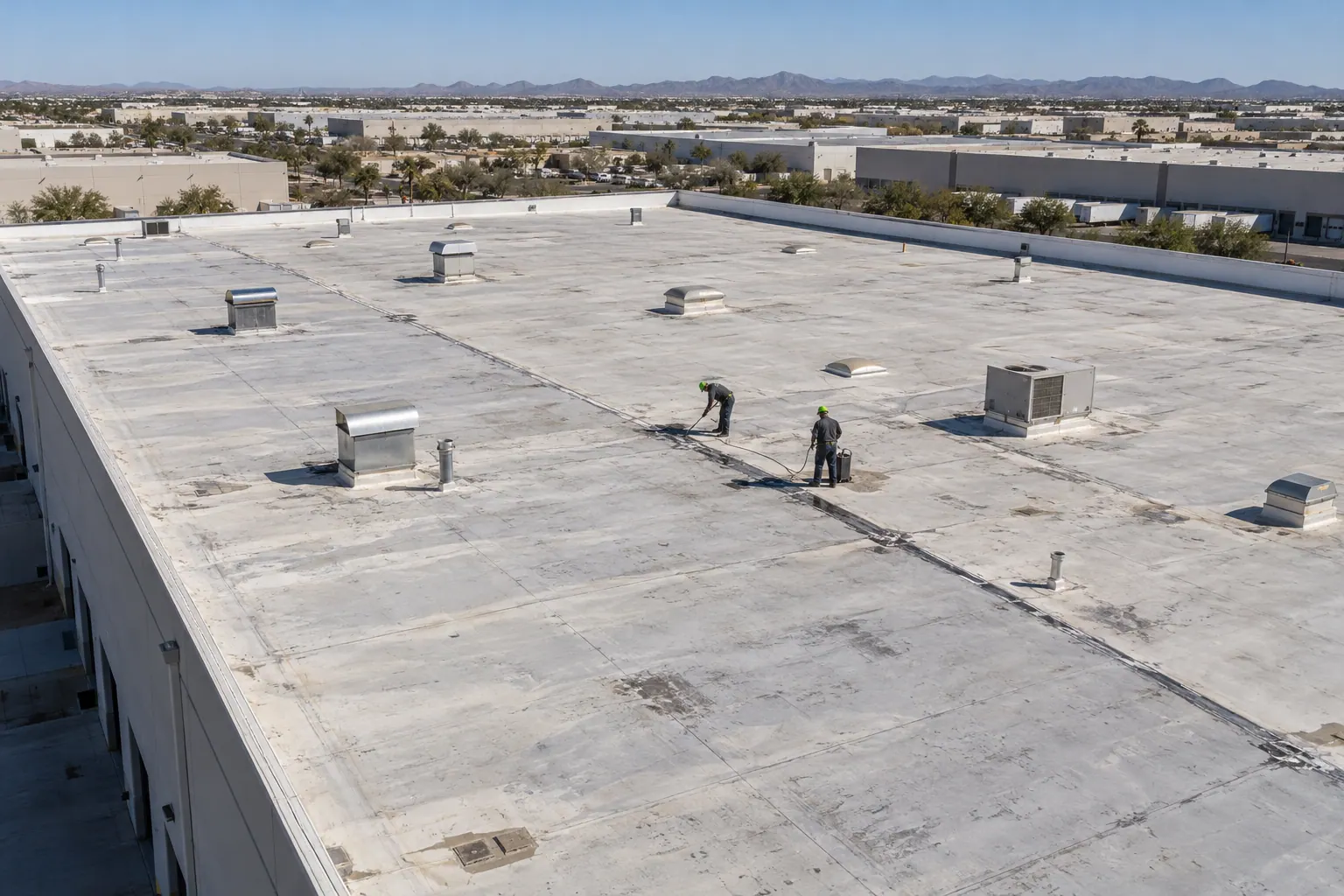
A repair holds on a flat roof when the leaks trace to details and the board underneath is dry. Here is how to tell.
On wide distribution and cold-storage roofs, these five details account for most of the leaks we repair.
Plan view, not to scale
Heat cycling opens TPO laps and splits built-up seams. We clean, prime, and weld or ply over them.
Packed strainers back water under the clamping ring, so the bowl gets cleared and the flashing renewed.
Dust and debris hold water at the wall, and the corners of the scupper liner crack first.
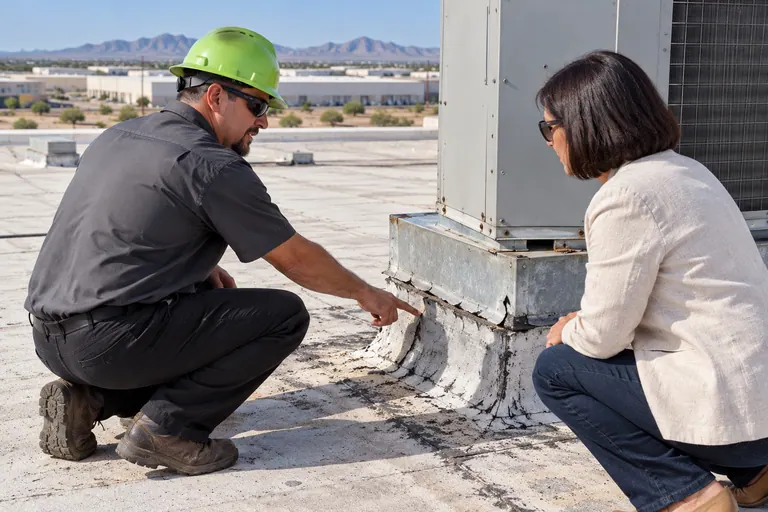
Flashing at rooftop units and exhaust fans pulls away as the curb moves with each cooling cycle.
Loose wall flashing and cracked coping send water behind the membrane at the wall line.
Boots dry out and split at the collar, and the gap lets water run straight down the pipe.
The repair depends on the membrane and the detail that failed. These are the ones we make most often.
| Repair | When It Fits | What It Involves |
|---|---|---|
| Welded TPO or PVC patch | Split seams, punctures, small tears | Clean and prime the sheet, hot-air weld a rounded patch, probe the new seam |
| Built-up roof repair | Blisters, splits, and open laps | Cut out damaged plies, add compatible felts with asphalt or mastic, resurface |
| Drain and scupper reflashing | Water at the bowl or wall opening | Clear the drain, reset the clamping ring, flash new membrane into the bowl or liner |
| Curb and pipe flashing | Leaks beside units, fans, or pipes | Strip old flashing, install new base and counterflashing, seal the boot |
| Wet insulation cutout | Soft or wet areas found by scan or core | Cut out the wet board, replace it, and patch the membrane over dry material |
| Coping and edge metal | Loose caps or lifted edges after wind | Refasten or replace the metal, reseal the joints, and tie the membrane edge back in |
Water that gets past a seam spreads sideways through the insulation. Stopping it early keeps the repair small.
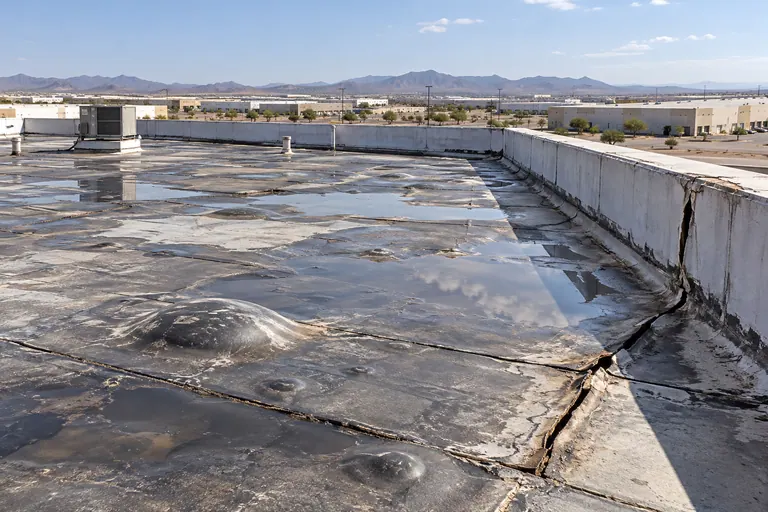
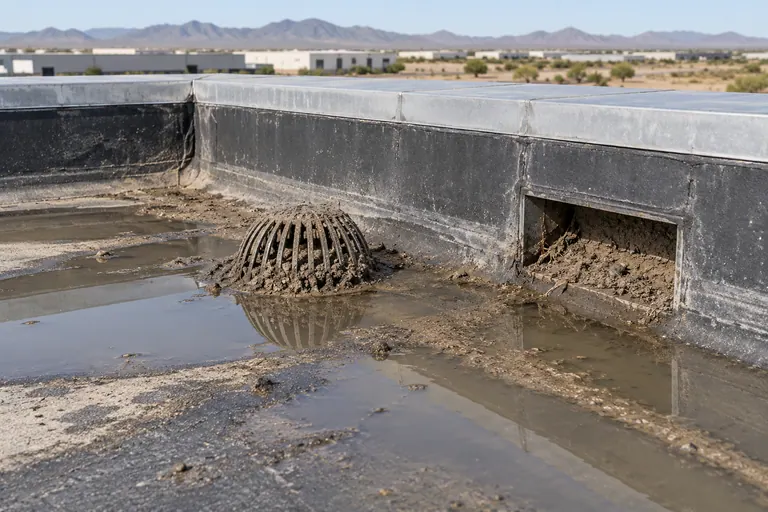
Ponding that stays long after the rain stops points to a blocked drain or a low spot. Call, and we will check the drain and the seams around it.
Four steps, each one aimed at the detail that let water in.

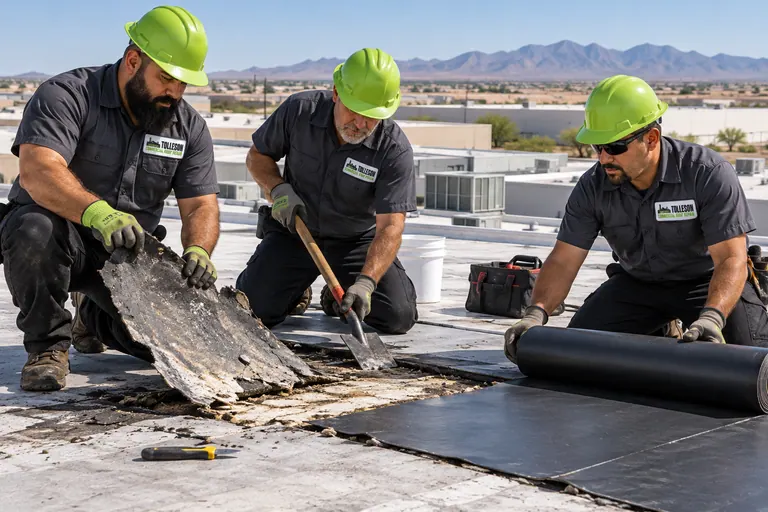
We walk the membrane, probe seams, check drains and scuppers, and scan for moisture so a patch never goes over wet board.
Damaged membrane and any wet insulation come out, cut back to dry material at every edge of the repair.
TPO and PVC get hot-air welded patches. Built-up roofs get compatible felts and asphalt, then resurfacing to match.
Every new seam is probed with a hand tool, then photographed, so you keep a record of what was fixed and where.
Flat roof work often overlaps with two other services.
If a stain keeps returning after a flat roof patch, the water is entering somewhere else, and a full leak trace finds it.
Commercial roof leak repair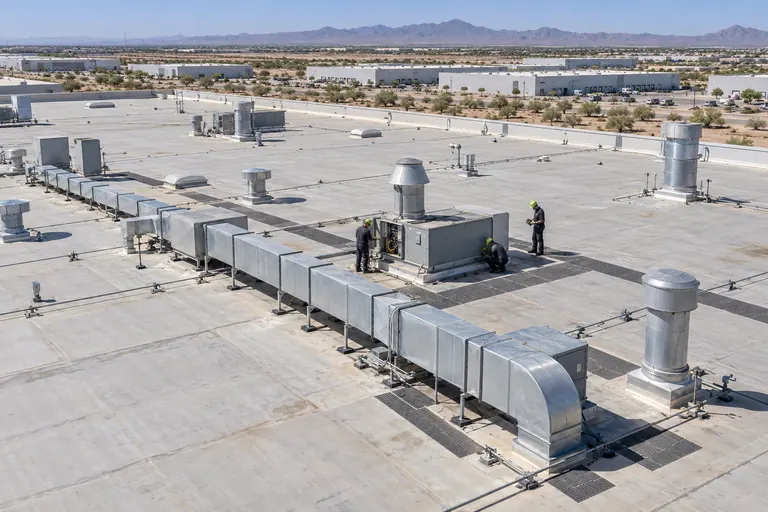
Flat roofs on food plants carry exhaust and makeup air units, and repairs near them need lockout and intake planning.
Industrial roof repairWhat owners of Tolleson flat-roof buildings ask most.
At the details, rarely in the open field. Seams lifted by heat cycling, drains and scuppers packed with dust, curbs around rooftop units, parapets with cracked coping, and pipe boots pulling away from the membrane cause most leaks on wide distribution and cold-storage roofs.
Often, yes. An older TPO sheet still welds when it is clean and the surface has not chalked through. We make a test weld first, and if the sheet refuses it, the patch switches to a compatible tape system.
Yes. PVC welds much like TPO, though the two sheets are not interchangeable, so the patch material matches whatever the roof already has. A quick test on a scrap confirms the type when no records exist.
Standing water should drain off within a couple of days after rain. Longer ponding loads the deck, wears the membrane, and points to a blocked drain or a sagging spot that needs a cricket or added drainage.
Both. Clearing a drain or reflashing a scupper often ends the ponding. A low area that holds water with clear drains can get tapered insulation or a small cricket during the repair.
Wet insulation is the biggest variable, because every soaked board has to come out. Roof height, hatch location, and the number of curbs or drains in the repair area add to it, and so does work scheduled at night.
Yes, with early starts. Membrane and adhesive work goes on in the morning hours, and crews stop before the roof surface gets hot enough to scorch hands or soften fresh asphalt.
Point us to the stain or the ponding. We will inspect, repair the detail, and send the photos.
Want A Call Back About Your Roof?
Leave a name and number, or call (623) 310-0161 now.